Elevating Visual Identity: The Strategic Value of Premium 3D Guitar Icons in Modern Design
In the rapidly evolving landscape of digital design and visual communication, the distinction between amateur and professional content often lies in the quality of individual assets. While typography and layout form the skeleton of any creative project, it is the imagery that provides the soul. For industries centered around sound, performance, and artistic expression, finding visuals that accurately capture the energy of music can be a significant challenge. This is where the premium 3D guitar icon emerges as a pivotal design element. Far more than a simple clip-art graphic, a high-fidelity, polished 3D render serves as a bridge between auditory concepts and visual engagement, offering a tangible representation of rhythm and melody for music schools, streaming platforms, concert promotions, and educational content.
The Evolution from Flat Design to Tactile Realism
To understand the significance of a premium 3D guitar icon, one must first appreciate the shift in modern user interface (UI) and user experience (UX) trends. For over a decade, flat design dominated the digital sphere, prioritizing minimalism and abstraction. While effective for utility, flat design often struggles to convey emotion or physical presence. As audiences have become desensitized to two-dimensional vectors, there has been a resurgence of "new skeuomorphism" or tactile realism. This design philosophy reintroduces depth, lighting, shadows, and texture to digital elements.
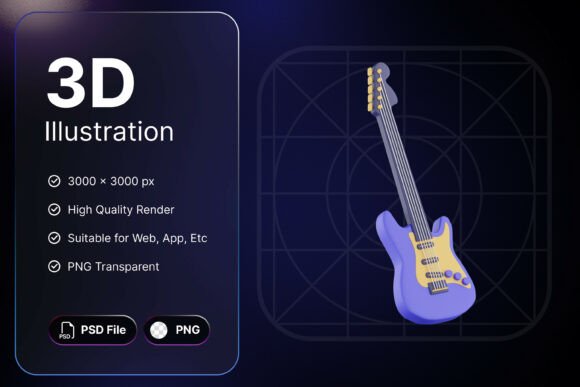
A polished 3D guitar icon embodies this evolution. It does not merely suggest a guitar through lines and silhouettes; it presents an object with weight, sheen, and dimension. When a user encounters this type of asset on a landing page or within an app, the brain processes it differently than a flat symbol. The specular highlights and soft shadows trigger a sense of familiarity and quality. For a music streaming platform, this translates to a subconscious association with high-fidelity audio. For a music school, it suggests professional-grade instruction and equipment. The visual metaphor aligns perfectly with the promise of the service: premium visuals imply premium experiences.
Strategic Applications Across Industries
The versatility of a high-resolution 3D guitar asset extends across multiple sectors, each utilizing the icon to solve specific communication problems. Understanding these applications helps clarify why investing in ready-to-use, high-quality assets is a strategic business decision rather than just an aesthetic choice.
Music Education and E-Learning
In educational contexts, clarity and engagement are paramount. Students learning music theory or instrument techniques respond better to materials that feel authentic. A generic, cartoonish guitar icon can inadvertently signal that the content is juvenile or overly simplified. Conversely, a sophisticated 3D render respects the intelligence of the learner and mirrors the craftsmanship of real instruments. Whether used as a module header in a Learning Management System (LMS) or as a thumbnail for video tutorials, this asset helps organize content while maintaining an atmosphere of academic and artistic rigor.
Streaming Platforms and Entertainment Branding
For streaming services and entertainment brands, the battle for attention is fought in milliseconds. Users scroll through vast libraries of content, making split-second decisions based on visual cues. A polished 3D guitar icon acts as a powerful pattern interrupt. Its depth creates a focal point that stands out against flat backgrounds and text-heavy interfaces. Furthermore, in concert promotions and event marketing, the glossy finish of a 3D asset complements stage lighting aesthetics, creating a cohesive brand identity that spans from digital ads to physical posters.
Creative Projects and Portfolio Presentation
Designers and content creators often need to represent musical concepts without relying on copyrighted photography of specific artists or trademarked instrument shapes. A stylized yet realistic 3D guitar offers a safe, universal alternative. It conveys the essence of rock, blues, jazz, or pop without legal encumbrances, making it ideal for commercial projects, blog headers, and social media campaigns where licensing clarity is essential.
Technical Specifications and Practical Implementation
When integrating premium assets into a workflow, technical specifications dictate usability. A beautiful image is useless if it lacks the resolution for print or the transparency for web layering. Understanding what makes an asset "ready to use" is crucial for efficient production.
- High-Resolution Fidelity: The standard for versatile design assets is 3000x3000 pixels at 300 DPI. This specification ensures the icon remains crisp on Retina displays and large-format prints alike. Scaling down preserves detail, whereas scaling up low-resolution images results in pixelation that undermines professionalism.
- Transparent Backgrounds: Versatility requires isolation. Assets delivered with transparent backgrounds (PNG format) allow designers to place the guitar over any color, gradient, or photographic background without tedious masking work. This is non-negotiable for UI kits and overlay graphics.
- File Format Flexibility: Receiving both PNG and PSD files covers immediate use and future reference. The PNG serves as the production-ready asset, while the PSD provides layer information that can be valuable for understanding lighting setups or composition, even if the primary asset is static.
Navigating Asset Limitations and Best Practices
It is vital to address a common misunderstanding regarding pre-rendered 3D assets. Many users assume that because a file includes a PSD source, they can alter every aspect of the object. However, premium pre-rendered icons often come with specific constraints: assets cannot be changed in color and shape.
This limitation is actually a feature of the product's value proposition. True 3D rendering involves complex lighting calculations, material shaders, and ray tracing that cannot be replicated by simply adjusting hue sliders in Photoshop. The "locked" nature of the color and shape guarantees that the lighting physics remain accurate and the polish remains intact. If you were to force a color change on a rendered shadow or highlight, the result would look artificial and muddy.
Therefore, best practices involve selecting an asset whose existing aesthetic aligns with your brand guidelines before purchase. Treat the icon as a fixed photographic element rather than a malleable vector. Use it as an anchor point in your design, building your color palette and typography around its established tone. This approach ensures visual harmony and prevents the degradation of the asset’s premium quality.
The Role of Visual Assets in SEO and User Engagement
From an SEO and content strategy perspective, high-quality visuals contribute significantly to page performance. Search engines increasingly prioritize user experience signals such as dwell time and bounce rate. Pages featuring engaging, relevant imagery tend to retain visitors longer than text-only pages. Furthermore, optimized alt text describing a "premium 3D guitar icon" helps search engines understand the context of the page, potentially ranking for long-tail keywords related to music design resources.
Additionally, unique visual assets reduce the likelihood of duplicate content issues associated with stock photography. When you utilize distinctive, high-resolution 3D renders, you differentiate your content from competitors using the same generic library photos. This uniqueness signals authority and originality to both users and algorithms, reinforcing the E-E-A-T (Experience, Expertise, Authoritativeness, and Trustworthiness) principles that guide modern search rankings.
Conclusion: Investing in Visual Excellence
The choice to use a premium 3D guitar icon is ultimately a choice about communication standards. In an era where digital noise is at an all-time high, clarity and quality are the only ways to cut through. Whether you are building a curriculum for aspiring musicians, designing the interface for the next big streaming app, or promoting a local concert series, the visual language you employ sets expectations before a single note is played.
By leveraging assets that offer high resolution, transparent backgrounds, and polished aesthetics, professionals can save time on custom rendering while achieving studio-quality results. Understanding the technical boundaries and strategic applications of these tools allows creators to integrate them seamlessly into their workflows. Ultimately, the right icon does more than decorate a page; it resonates with the audience, translating the intangible beauty of music into a visual form that inspires, informs, and engages.